
For my final course in the NAU Data Science Bachelor program, I completed a capstone project that needed to be done with another person. Gabriel Cage-Sepeda, an actuarial student who was close to the data science students, chose to do a data-oriented capstone project with our group, and he and I partnered up. Along with this project, we needed to compete in the American Statistical Association (ASA) DataFest, which is a hackathon-style competition about data in which teams of undergraduates work around the clock to find and share meaning in a large dataset. More about that in an earlier post.
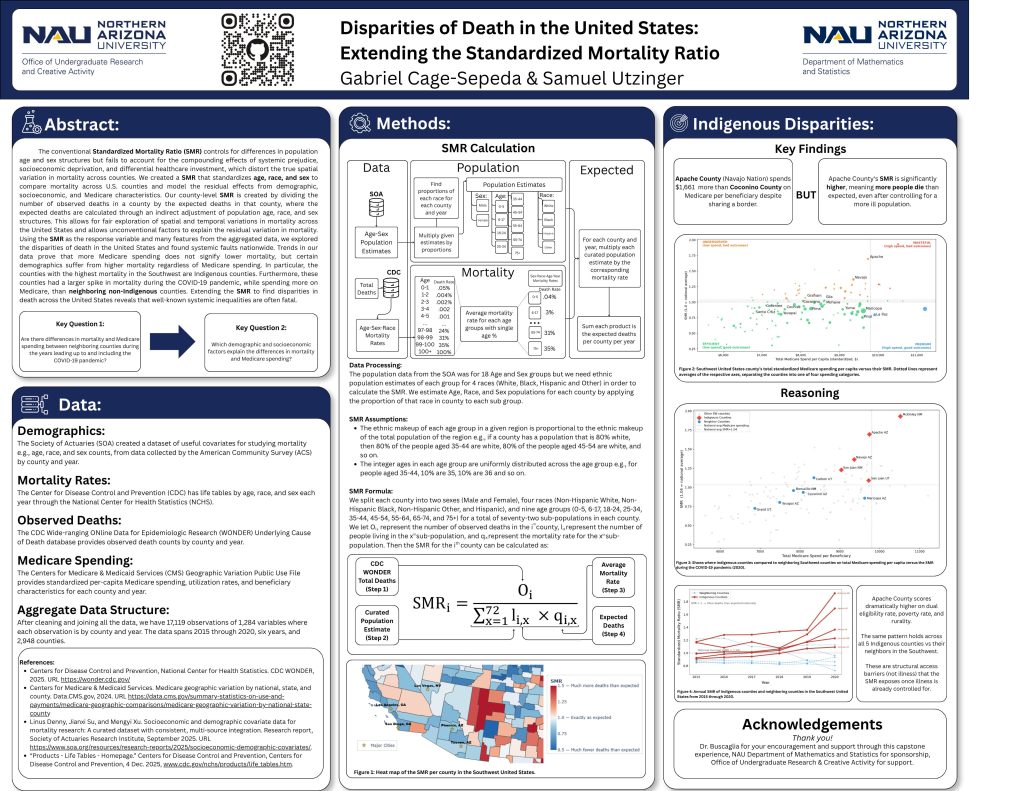
For the thesis project, we chose to look at Standardized Mortality Ratio, a statistics-based analysis that uses standardization to predict deaths. Using data from many different national foundations, we created a per-county dataset that gives population estimates of highly specific sub-populations based on age, race, sex, and location. We also collected data on mortality rates for each group in these counties based on historical counts to predict and analyze current death rates.
Our major finding from this project was the health disparity in Native American nations’ death rates. My school sits on sacred land of the Navajo Nation, and it is very important to our school that we study and acknowledge these issues. We showed that compared to neighboring counties, native American counties spent $1,661 more on their healthcare per person while still having higher mortality rates, and that during COVID they were unable to handle the excess deaths as well as the rest of Arizona, pointing to difficult access to medical resources. The more spent on healthcare did not result in fewer deaths, actually the contrary: the more spent on healthcare had a positive correlation with deaths, but this survivorship bias approach makes sense. Sicker counties need more spending on healthcare due to the increase in mortality (correlation does not equal causation).